Preparation and care-team questions · Updated 4 November 2026
How to Write a Birth Plan Without a Template: A One-Page Preferences Guide
Start with what matters to you, then separate preferences from questions that need a discussion. A plain page can help your maternity team understand your wishes without making you decide every birth option in advance.
Start with this
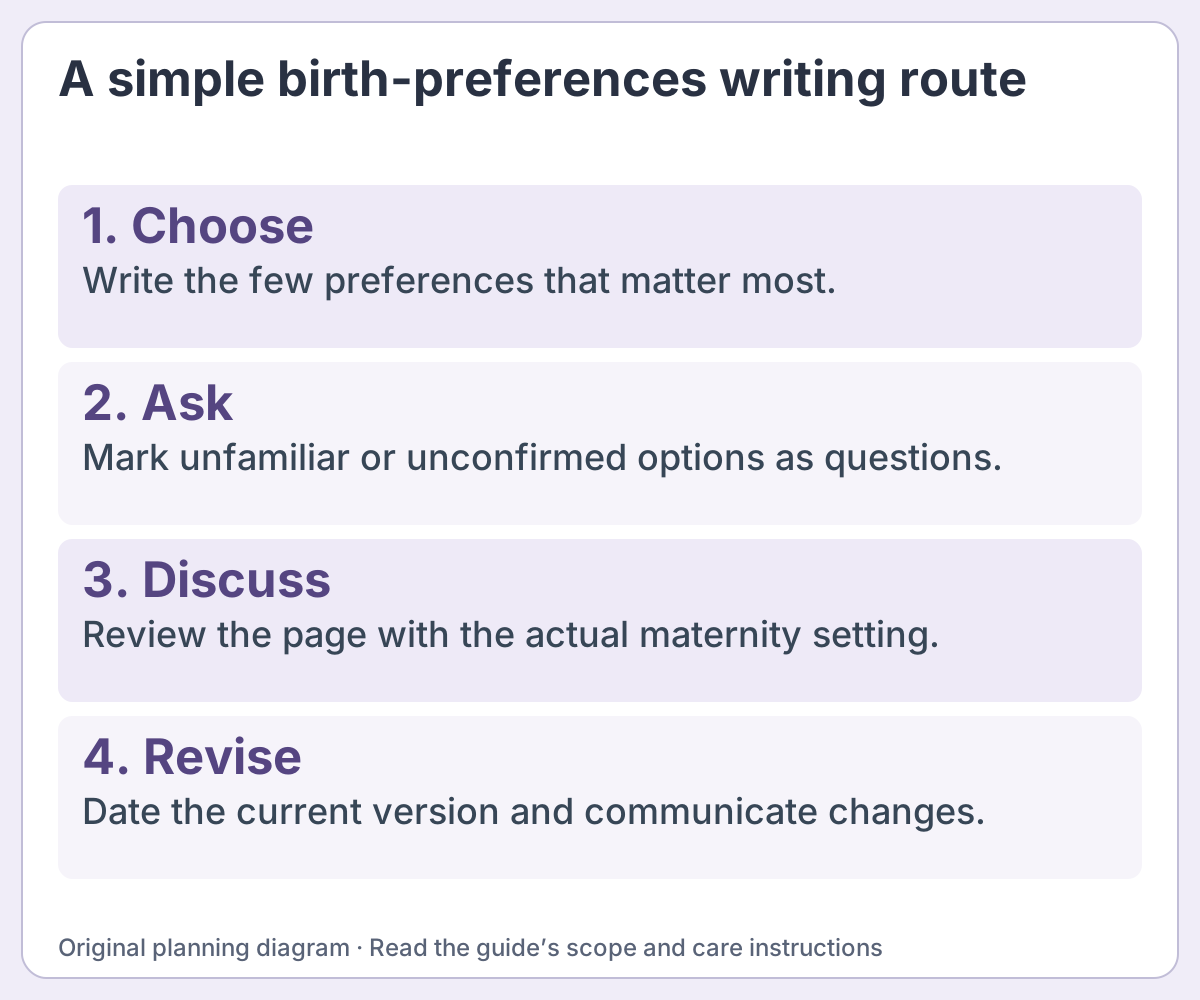
Write three priorities, one question that needs confirmation and how you would like changes explained. Ask your maternity team when and how to review the page; keep a clearly dated current version.
Write the purpose before the preferences
A birth plan is a way to communicate what you would like during labour and birth. The NHS describes it as a chance to discuss the birth setting, the people with you and the facilities you would like to use. You can write those preferences on a plain page; a downloaded form is optional.
Begin with a short sentence: “These are my preferences and the questions I want to discuss with my maternity team.” That makes the purpose clear without implying that every option is available or that a document decides which care is appropriate. The team needs to understand both what matters to you and what remains uncertain.
One page is a practical starting point because important points are easier to find. It is not a rule about the length a hospital accepts. If there is a complex history, a separate care plan or detailed instructions from your team, ask how those documents should be included or referenced. Keep medical instructions separate from a list of personal preferences.
Choose the few preferences that matter most
Write the preferences you already have, then mark the rest as questions. You do not have to invent an opinion about every possible procedure. A useful distinction is “I prefer”, “I would like to discuss” and “I am open to options once they have been explained.” Each phrase tells the team something different.
Communication and support are good places to start: how you would like explanations given, who you want with you, whether you want an interpreter and what helps when you are concentrating. Include any clear preferences about photographs or who can receive updates. Ask the setting how these wishes can be supported.
The NHS checklist also suggests discussing the birth location, equipment, movement and positions, pain relief, skin-to-skin contact, feeding and newborn care. These are topics for a conversation, not a list of choices you must make independently. If you do not understand an option, write the question rather than selecting a response because a template has a checkbox.
| Topic | Plain wording | Question to confirm |
|---|---|---|
| Communication | “Please explain the next step in plain language.” | “How can I ask a question if I need more explanation?” |
| Support person | “I would like this person with me, if permitted.” | “Which attendance rules apply during labour, procedures and recovery?” |
| Comfort or facilities | “I would like to discuss movement, positions or a birth pool.” | “What is available here, and what might change whether I can use it?” |
| Pain relief | “I would like information before deciding.” | “When should we discuss the options and my own circumstances?” |
| After birth | “I would like to discuss skin-to-skin contact and feeding support.” | “How would these be supported if either of us needs extra care?” |
Ask what the birth setting can actually provide
A plan is easier to use when preferences have been discussed with the service that will provide care. Check who should review it, when to bring it and whether the team wants a copy in a portal, printed notes or another record. An uploaded file is not the same as a confirmed discussion.
Ask about the specific wish rather than whether the whole plan is “approved”. For example: “Is this facility available here?” or “If my support person cannot attend, what alternatives can we discuss?” Write the answer and any unresolved question next to the preference so you do not mistake an assumption for confirmation.
If a preference is unavailable, ask what need it was meant to meet and which alternatives could help. A wish for a quiet environment may lead to a useful communication discussion even if a particular room cannot be promised. Do not treat another person’s birth story as a guarantee of the facilities or staffing you will have.
Include wording for a change of plan
The NHS emphasises that birth does not always follow the plan and that things may need to change. Ask your maternity team how they will explain changes, what questions you can ask and how your support person can help you be heard. A practical change paragraph is about communication; it is not an advance decision about every clinical possibility.
You might write: “If something changes, please explain the reason and the options as the situation allows. Help me understand what happens next and which preferences can still be supported.” Discuss that wording with the team, particularly if previous experiences make communication important to you.
A preference page does not replace informed consent, an individual care plan or emergency procedures. Your support person can know what you have written without becoming the decision-maker. If you change your mind during labour, say so; an earlier copy should not be used to pressure you into keeping a preference you no longer want.
Make the page easy to identify and revise
Add the name you want staff to use, the intended birth setting and the date you last discussed or revised the page. Include the identifying details the service asks for, but do not post a completed plan publicly. Share private information through the care service’s appropriate route.
Keep one current version. If you change a preference, update the date, tell the people who need the change and ask the team how an earlier copy should be replaced in their records. A support person holding a different version can unintentionally repeat an outdated wish.
Before a review conversation, choose the two or three questions that still need answers. You can leave with a short action list: who will answer, where the response will be recorded and whether you need another discussion. The goal is a useful exchange with your team, not a perfectly formatted page.
A simple page you can adapt
The following structure is an original writing example. It is not a completed care plan or a recommendation about which birth options to choose. Replace each prompt with your own preference or question, and discuss it with the maternity team.
Name and review: the name you want used; intended setting; latest revision date; how the service wants the page identified.
What matters most: two or three communication, support or comfort priorities in your own words.
Preferences to discuss: support person; explanations or interpretation; facilities and movement; pain-relief questions; after-birth contact, feeding and newborn-care questions.
If things change: how you would like explanations and support, with room for the team to discuss the current circumstances.
Unanswered questions: what needs confirmation, who you will ask and where the answer will go. Use the downloadable sheet below to keep these categories on one page.
Four situations to work through
These are fictional planning examples. They illustrate a useful question or support task; they do not assess a person’s health or predict an outcome.
Example 1: You have not chosen a pain-relief preference
A reader leaves the pain-relief section blank because they feel they should already know what they want. Instead, they write “I would like to discuss the available options, how they are used here and any considerations in my own situation.” That is a useful question, not an incomplete plan.
At the review conversation, they ask when this discussion should happen and where the information can be found. They do not choose a method from a stranger’s account or treat an online comparison as advice for their pregnancy. Their preference page records the need for information and can be revised after that conversation.
Example 2: A facility you hoped for is not available
A reader learns that a particular facility cannot be offered at the intended setting. They mark it unconfirmed or unavailable, then ask what alternatives might meet the same need. They can still describe why comfort, movement or privacy matters to them.
The useful result is a clearer conversation about the actual service, not a demand that staff promise something they cannot provide. If the intended setting itself is being reconsidered, that belongs in a discussion with the maternity team about options and circumstances. Keep the current page clear about what has and has not been agreed.
Example 3: The planned birth changes
A change in circumstances means the original description of the birth is no longer useful. The reader asks the team to explain the current plan and which support or communication preferences can still be included. Their support person helps remember questions rather than insisting that an earlier page must be followed.
The preference document remains useful as a way to be heard, but it does not decide the clinical response. After the discussion, the reader updates practical details such as where the support person should go and which arrangements need confirmation. A changed plan is not evidence that the person has failed at birth planning.
Example 4: Two copies contain different preferences
A support person has an older printed page while the reader has revised a digital copy. Before the next conversation, they compare the revision dates, identify the current wording and tell the maternity team that an earlier version exists.
They ask how the service wants the update recorded and stop distributing the outdated personal copy. If a preference changes again during labour, they communicate the current wish rather than relying only on dates. Version clarity helps with communication; it does not replace a consent discussion or mean a signed-off format is required everywhere.
Questions readers ask
Is a template required?
The NHS describes a birth plan as a way to communicate wishes and offers a template as an option. A plain page can also organise the conversation. Ask your own setting whether it has a preferred format or record process, and use that process where needed.
How detailed should it be?
Make the important preferences easy to find and keep unanswered questions visible. One page is a practical starting point, not a universal limit. If your team has a separate care plan or needs more information, ask how to include it without burying your communication priorities.
Can I change my mind?
Tell the team what you want now and ask how the change will be recorded. Birth preferences can change before or during labour. A previous written wish should not become pressure to keep something you no longer want.
Should I include every newborn-care choice?
Include the topics you want to discuss, such as feeding support or skin-to-skin contact, rather than deciding unfamiliar questions because a form lists them. Ask the maternity team how routine newborn care is explained and how choices or extra-care circumstances are discussed.
Choose the next guide for your task
- Agree a birth support role — Explain how a companion can support communication and practical tasks.
- Organise maternity admission documents — Keep the preference page with the records the setting requests.
- Confirm what the maternity hospital provides — Ask about facilities and belongings without assuming they are supplied.
- Request an interpreter for maternity care — Prepare language-support arrangements for care discussions.
Download the preparation sheet
Download the blank birth-preferences preparation sheet (TXT). Adapt the prompts privately and discuss the page with your maternity team. The sheet is a writing aid, not a consent form or individual care plan.
Sources and scope
NHS guidance supports discussing preferences with the maternity team and recognising that plans can change. The examples here concern writing and communication. Availability, informed consent, clinical decisions and emergency procedures depend on the actual service and circumstances.
Sources accessed 4 November 2026. This article is educational preparation, not an individual assessment or clinical treatment plan.