Practical guide
Maternity Discharge Transport: A Planning Checklist
Confirm the ward plan, actual driver and vehicle, infant seat instructions, practical help and home arrival. Use two records to reveal what still needs an answer.
Start with five confirmations, not a promised leaving time
A useful maternity discharge transport plan names the person waiting for the ward's update, the driver and actual vehicle, the pickup point, any help getting to the vehicle, and the person helping when you arrive home. Add the baby’s transport requirements and the discharge instructions you need to take with you. A packed hospital bag does not answer those questions.
If departure is being discussed, ask the ward what remains to be completed for you and your baby. Do not treat a booked ride, a friend's past experience or an estimated time as a discharge decision. The maternity team decides the care arrangements; your plan makes it easier to act when they give their instructions.
The Rosie Hospital's going-home page asks families to arrange pickup by car with a baby car seat and, where possible, help at home. Its published timings and document arrangements describe that hospital. They do not establish a leaving time, required number of helpers or paperwork deadline for every maternity unit.
If you or your baby develop an urgent concern, tell staff immediately while you are still in hospital. After leaving, seek appropriate urgent or emergency care. Trouble breathing, chest pain, severe headache, heavy bleeding or thoughts of harming yourself or your baby are among the CDC's urgent maternal warning signs. This is not a complete symptom list. A transport checklist should never become a reason to finish packing, wait for a routine ride or postpone care.
Ask the ward what happens between “going home” and departure
Make the ward conversation specific enough for a driver who is outside the building. “We might leave today” is an update, but not an instruction to park at the entrance now. Ask who will tell you when the departure arrangements are confirmed and how the pickup person should receive that message.
| Topic | Question to ask | What to record |
|---|---|---|
| Departure update | Who will confirm the current plan for me and my baby, and how will we hear? | Contact or staff role; next update, if given. |
| Pickup location | Which entrance or pickup point should the driver use? | Named place, access instructions and any parking limits. |
| Getting to the vehicle | What help is available or appropriate if walking, lifting or getting into the car is difficult? | The practical arrangement your team recommends. |
| Baby transport | Does my baby need any individual transport advice before leaving? | Team instructions; questions that still need an answer. |
| Take-home information | Which notes, medicines or follow-up details should leave with us? | Where they are packed and who can find them. |
| Plan changes | Who should we tell if the driver, vehicle, destination or timing changes? | Ward contact and the next confirmation needed. |
| Limited support | I do not have the transport or help assumed in the usual plan. Who can help us discuss options? | Relevant staff or service and agreed next step. |
Write the actual answer, including “not yet confirmed,” rather than a generic tick. Ask for an explanation or interpreter if you need one. If you are tired or uncomfortable, a person you choose can help take notes with your consent; they do not have to speak for you or receive every private detail.
Keep administrative arrangements local. For example, Rosie describes postnatal notes and separate discharge information for community professionals. Your hospital may use a different paper or digital system. Ask what you should carry, who has already been informed and whom you should contact if the instructions cannot be found.
Give each practical task an owner and a backup
The person supporting you during birth may not be the driver. A driver may also be looking after another child, working at a fixed time or using a vehicle that cannot accommodate the planned seat. Agree on the tasks before assuming that “someone will pick us up” is enough.
| Task | Named person or service | What they need | Backup question |
|---|---|---|---|
| Receive the ward update | Your chosen contact. | Agreed way to receive the current departure message. | Who receives it if that phone is unavailable? |
| Drive or arrange the ride | Driver or confirmed transport provider. | Pickup location, actual vehicle and current plan. | Who is available if the plan changes? |
| Handle belongings | Person able to manage the bags. | Which bags and information need to leave together. | What help can the ward discuss if none is available? |
| Help with access | Chosen helper or agreed staff assistance. | The instructions for walking and entering the vehicle. | Is the pickup point accessible for the current need? |
| Check seat instructions | Person responsible for the seat. | Correct seat and vehicle manuals; unresolved fit questions. | What changes if a different vehicle arrives? |
| Prepare home arrival | Person or service you have arranged. | Keys, destination and the first practical job. | Who can help if arrival is later than expected? |
| Keep care information available | You or a person you choose. | Discharge instructions and relevant contact route. | Where is the private copy if a phone fails? |
These are tasks, not seven required people. One person may cover several, and a solo parent or a family without a birth partner may use other arrangements. Tell the ward about a gap early so the plan reflects the support you actually have.
After a caesarean birth, do not plan on driving yourself home. The NHS recovery guidance says to arrange a lift when you are well enough to leave because you will not be able to drive for a few weeks. It also notes that some activities, including carrying more than your baby, may need to wait. Ask your team about your own recovery and medicines, and have someone else manage luggage or a heavy seat where needed. This guide does not give a date to resume driving or clear anyone to lift.
Check the actual seat and vehicle, not a generic installation diagram
For a car journey, prepare an appropriate seat and learn its instructions before the expected departure. The US NHTSA guidance recommends rear-facing travel for infants under one year and choosing a seat for the child's age and size that fits the vehicle. It explicitly directs parents to both the particular seat manufacturer's instructions and the vehicle owner's manual. Local rules and product approvals also matter; this is not a statement of the law in every country.
Identify the exact model rather than only the brand or a product-family name. As one manufacturer example, Graco's instruction-manual finder offers category or model-number lookup and explains where model numbers are commonly located. Its parts section also asks for the model and manufacture date. Another brand may have a different lookup method. This example is a way to find instructions, not a recommendation to buy a Graco product or confirmation that any particular seat is suitable.
| Check | Find in the applicable instructions | Keep unresolved if you cannot verify |
|---|---|---|
| Exact product | Seat model, manufacture date and matching manual. | A manual for a similar-looking seat is not confirmation. |
| Baby fit | Applicable weight, height and other fit requirements. | Ask about an individual fit or transport concern. |
| Position and direction | Approved direction and vehicle seating position. | Do not infer approval from available space alone. |
| Installation method | Seat and vehicle instructions for the permitted method. | Do not combine methods to improvise a better fit. |
| Harness and recline | The relevant harness adjustment and recline directions. | Do not invent a universal angle or strap setting. |
| Inserts and accessories | What the manufacturer permits for this model. | Extra padding or an accessory needs verification. |
| Carrier and base | Instructions for the carrier, base and handle, where applicable. | A carry handle position is not automatically the travel position. |
| Help with use | Official support and an appropriate seat-check service. | A completed worksheet is not a physical inspection. |
Do the instruction check for the vehicle actually making the journey. A backup car can have different seating, belts or permitted attachment positions. A seat being available does not prove that it has been installed correctly or that the baby fits it. NHTSA describes help from certified child-passenger-safety technicians and inspection stations in the US; look for an appropriate service where you live. Hospital staff roles and inspection services vary, so do not assume the ward will fit or certify the seat.
For a baby with an individual medical or transport need, ask the maternity or neonatal team what arrangement applies before departure. Do not create a special positioning method from this general checklist. Likewise, use the actual instructions for clothing, inserts and accessories rather than adding improvised padding to solve a fit concern.
Make the backup plan complete enough to use
A backup is more useful than “we will call someone” when it answers who can come, which vehicle will arrive and how the seat requirements will be met. Recheck the pickup location and support needs when the departure time changes. Keep the driver informed without pressuring the team to discharge you to fit the ride.
If using a taxi, private hire or another service, confirm the specific arrangement in advance: the vehicle, appropriate infant restraint, permitted installation and any provider or local requirements. Do not assume a seat will be supplied, that a legal exception establishes a safe plan, or that holding the baby substitutes for a suitable restraint. Ask the ward for help discussing options if your planned transport cannot be used.
If an ambulance, patient transport or medically arranged journey is needed, follow the arranging team's instructions. Do not apply a private-car worksheet as though it specifies the equipment or position for medical transport. A hospital pickup request is also not a guarantee of transport funding or eligibility; ask the relevant local service.
Keep two changes separate. A late driver is a logistics problem to raise with the ward. A new health concern requires the care response it needs. If symptoms occur, tell staff or seek urgent help rather than repeatedly calling the usual pickup person while delaying the clinical contact.
Plan the first few practical steps at home
Home arrival can expose small gaps: the person with the keys is away, bags block the doorway, or the care information is in an unavailable phone. Name the first useful job for your helper, such as opening the door, bringing in belongings or keeping the discharge information easy to find. Keep that job separate from interpreting symptoms or changing the care plan.
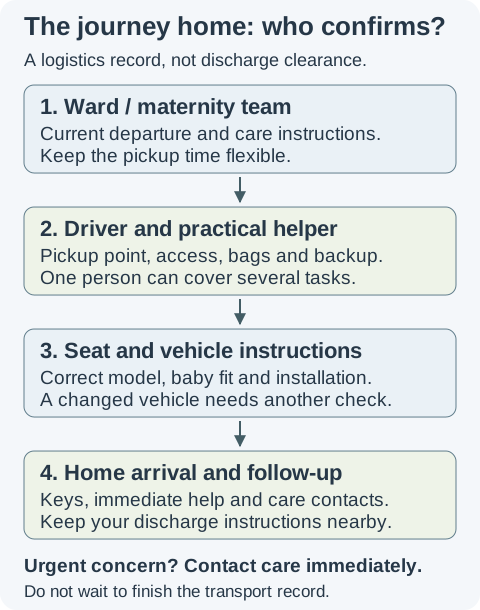
Ask where the instructions for your recovery, your baby's care, prescribed medicines and follow-up are recorded. You can organize their location without rewriting doses or substituting a generic schedule. If you do not understand something, ask the team before relying on memory during the journey.
Give the driver the pickup information they need; give a home helper the practical job they have agreed to do. Keep health documents and personal contacts private, using the hospital's appropriate route when sharing information with care services. A small paper backup can help with a flat phone battery, but it should not become a public group-chat copy of your medical record.
Four fictional plans show what still needs confirming
These invented examples illustrate planning decisions. They are not accounts of assessed families, inspected seats or medically approved discharge arrangements.
1. The recovering parent is listed as the driver
A person preparing for a caesarean birth has written “drive home ourselves” because the car will be in the hospital car park.
Better plan: arrange another driver and ask the maternity team about help with walking, belongings and getting into the vehicle. Leave driving-resumption advice with the relevant professionals.
Having a parked car solves availability, but does not make the recovering person ready to drive.
2. The backup arrives in a different vehicle
The first driver becomes unavailable. A friend can come, but the seat has only been checked in the original car.
Better plan: tell the ward about the change and check the seat and replacement vehicle instructions. Resolve installation or fit questions with appropriate help before using the new arrangement.
The same seat model does not make every vehicle installation identical.
3. A solo parent has no person for the bags
The ride is arranged, but no separate helper is available to carry belongings from the ward.
Better plan: explain the specific support gap to staff before departure and ask what practical assistance or alternative arrangement can be discussed.
The checklist should reveal the task needing help, rather than impose a family structure or imply that several companions are compulsory.
4. A booked ride arrives before the care conversation is finished
The driver is waiting, but the family still has an unanswered question about the baby's transport instructions.
Better plan: tell the driver that the time is not yet confirmed and ask the team to resolve the question. A reservation does not replace the ward's instructions.
If an urgent concern is involved, contact care immediately. Do not convert the ride's waiting charge into a reason to skip the care response.
Use two records and six checks to find the unfinished part
Complete only what you have confirmed. Put an owner beside each unanswered question, and update the record when the driver, vehicle, destination or care instructions change. You can leave a private phone number or health detail off a shared working copy.
MATERNITY DISCHARGE — PICKUP AND ARRIVAL RECORD
Ward's current departure instructions and who confirmed them:
Person waiting for the ward's update; private contact:
Driver, vehicle and agreed pickup point:
Support with bags, walking and entering the vehicle:
Seat and vehicle manuals checked for this actual vehicle:
Unresolved question and who will answer it:
Backup driver or transport; what must be checked again:
Person meeting us at home and the first practical task:
Discharge notes, medicines and follow-up contacts located:
SEAT AND VEHICLE — INSTRUCTION RECORD
Seat brand, exact model and manufacture date:
Correct manual or official support route:
Vehicle model/year and its relevant manual section:
Baby's fit requirements checked against this seat's instructions:
Approved installation method and seating position:
Harness, recline, inserts and handle instructions located:
Question for the manufacturer or qualified seat technician:
Plan if the seat or vehicle changes:
This record is not an inspection, discharge decision or safety certificate.
Download both blank records, the question tables and six explained planning cases. The blank fields and cases organize questions; they do not provide medical clearance, installation certification or transport eligibility.
Case 1
The ward gives an estimated departure time and a driver books a ride. Does that establish discharge clearance?
Show answer and explanation for case 1
No. Confirm the current departure and care arrangements with the ward.
The transport booking organizes a ride. It does not decide readiness or replace the maternity and baby-care instructions.
Case 2
A parent recovering from a caesarean birth plans to drive home. What should the transport plan change?
Show answer and explanation for case 2
Arrange another driver and ask the team about practical recovery needs.
NHS guidance says to arrange a lift after a caesarean because driving will not be possible for a few weeks. This checklist does not supply an individual return-to-driving date.
Case 3
A different vehicle is used for the backup pickup. Is the previous seat installation check enough by itself?
Show answer and explanation for case 3
No. Check the instructions for the actual seat and replacement vehicle.
Available space and a familiar seat do not verify a permitted installation. Resolve the new questions with the manufacturer or appropriate qualified help.
Case 4
A seat worksheet has all fields completed. Does it certify correct installation or replace an inspection?
Show answer and explanation for case 4
No. It records what was checked and what remains unresolved.
A general article cannot inspect the physical seat, installation or baby fit. Use the applicable manuals and an appropriate checking service when needed.
Case 5
Someone has no birth partner or separate helper for luggage. Does the task table require several companions?
Show answer and explanation for case 5
No. Explain the practical gap to the ward and discuss the available arrangements.
The rows describe jobs, not a mandatory number of people. A realistic plan names the help available and the task still needing a solution.
Case 6
Trouble breathing begins while the routine pickup is delayed. Should the family first complete the record and call the driver again?
Show answer and explanation for case 6
No. Tell staff immediately in hospital, or seek appropriate urgent or emergency care after leaving.
Trouble breathing is among CDC urgent maternal warning signs. A routine transport arrangement must not delay the care response; the warning-sign list is not exhaustive.
Sources and further reading
- Cambridge University Hospitals: Rosie Hospital — Going homeLocal pickup, help-at-home and discharge-information example; not universal timings or paperwork deadlines.
- NHS: Caesarean section — RecoveryArranging a lift after caesarean birth and discussing lifting, recovery and return to driving with your care team.
- NHTSA: Car Seats and Booster SeatsUS guidance on infant rear-facing travel, using seat and vehicle manuals, and finding qualified installation help.
- Graco: Instruction ManualsAn official category/model lookup and model/manufacture-date information for finding the applicable instructions.
- CDC: Urgent Maternal Warning Signs and SymptomsUrgent concerns need immediate care; selected warning examples are not a complete list or a personal triage assessment.