Practical guide
Requesting an Interpreter for Maternity Care: Questions and Preparation
Tell your maternity team the language and dialect you need, ask how professional interpreting is arranged, and check that the answer matches this appointment. Use four short messages, a confirmation record and eight examples to make pending questions visible.
Tell the maternity service what communication help you need
To request an interpreter for maternity care, contact the team arranging your appointment or admission and state the language you need for a healthcare conversation. Include the dialect where relevant, the appointment details and any separate need for written or signed communication. Ask how the request is made and how you will know it is confirmed.
You do not have to wait until you cannot understand anything at all. Everyday conversation, a medical explanation and written instructions place different demands on language. You may manage ordinary English and still prefer professional interpreting when discussing a scan, a procedure, birth preferences or aftercare.
The UK government interpreting guide explains this difference and recommends recording language needs in the health record and passing them on with referrals. This article turns those principles into a practical request and confirmation record. It does not assess an individual’s care needs.
Make the routine request as early as you can, using the service’s approved contact route. If a maternity concern needs urgent attention, follow your team’s urgent contact instructions and state the language help needed during that contact. Do not wait to finish this worksheet or obtain a routine interpreter booking.
Separate spoken, written and other communication needs
“I need language help” is a useful start. A more precise request gives the booking team information it can use. Name the language you understand best for discussing health and, if needed, the dialect or variety. A broad language label may leave an important distinction unresolved.
| Need | What to describe | An example or check |
|---|---|---|
| Spoken discussion | The language and dialect you understand best for healthcare. | “I need Cantonese for the conversation.” |
| Written information | Your preferred written language and whether reading it is useful. | “I can read simplified Chinese; please also explain the instructions aloud.” |
| Signed communication | The signed language and any other access requirement. | Name your actual signed language rather than requesting a generic sign-language interpreter. |
| Appointment messages | How to receive and understand booking or change information. | Ask how to make, cancel or rearrange an appointment with language support. |
| Session preferences | A relevant preference or concern, such as interpreter gender or privacy. | Ask whether the service can meet the preference; keep it pending until answered. |
| Another service | What happens when a clinic refers you or an admission begins. | Ask whether your communication needs will be passed to the receiving team. |
These examples are original request prompts, not a list of services guaranteed by every hospital. A preference for a particular interpreter, continuity across visits or a particular session format needs an answer from the service. Tell staff why a preference matters to communication or privacy, without having to put sensitive details into an ordinary booking message.
Keep spoken and written language separate. Someone may understand a spoken language well but find its written form difficult, or prefer a different written language. Ask for information in a form you can actually use. The government guidance discusses spoken explanations and visual aids as additional support; a picture alone does not replace an interpreted conversation.
Find the team that arranges the service and check local details
Start with the maternity appointment letter, your midwifery team or the clinic’s published contact route. Ask which team arranges professional interpreting for this visit. You are asking the care service to coordinate communication support, rather than independently guessing which interpreter should attend.
Cambridge University Hospitals provides a concrete local example: its before-your-appointment page asks people to communicate accessibility or communication needs during referral and before the appointment where possible. It also publishes a CUH Accessibility contact route. The page covers hospital appointments generally; it does not establish a specific interpreter booking for every Rosie maternity setting.
If that is your hospital, use the current published details and ask how they apply to your maternity visit. Elsewhere, use your own hospital’s equivalent route. The useful principle is early communication and a named next step, not copying another institution’s number.
The UK government guide states that NHS providers are responsible for making interpreting and translation available free at the point of delivery. That statement concerns the NHS context described by the source, last updated in March 2021. It is not a worldwide promise about private services, fees or availability. Ask your service about the process and any uncertainty before arranging a paid alternative.
Use a short request, follow-up or change message
Keep a request short enough for the team to identify the visit and respond. Use the approved patient contact channel, supplying the identifying details the service asks for. Do not post a filled health record publicly or send it to an address copied from an unrelated directory.
First request
I have a maternity appointment with [clinic] on [date and time]. I need a professional interpreter in [language and dialect]. Please tell me how to request one, whether this is confirmed, and how I will receive the answer. I also need help understanding [appointment messages / written information].
Check a pending request
I requested an interpreter for [appointment]. The language is [language and dialect]. Please check whether the request is confirmed for this date and tell me how the session will work. Is there anything still waiting for an answer?
Update a changed appointment
My appointment has changed from [old date] to [new date and time]. Please check the language-service booking too, and tell me whether the old booking is cancelled and the new one is confirmed.
Ask for clarification during care
I have not understood that explanation. Please pause and explain it again through the interpreter. I would like to describe it back in my own words and check that I have understood.
The scripts are original English wording you can adapt. They are not certified translations into another language or an emergency phrasebook. If making the initial contact in English is itself difficult, ask the service how to access its booking or telephone support with language assistance. The government guidance recognises that booking, cancelling and reading appointment letters can need language support too.
Confirm the booking, format and route for changes
A request being sent is different from the service confirming an arrangement. Keep those states visible in your notes. “Requested” can be correct and useful; changing it to “confirmed” before an answer only hides what still needs attention.
| Detail | What to record | Question to ask |
|---|---|---|
| Correct appointment | Clinic, date, time and location or remote appointment. | Does the interpreter request match this visit? |
| Language match | Language, dialect and signed-language requirement if relevant. | Is the requested language recorded correctly? |
| Booking status | Requested, confirmed or a detail still pending. | Has the service booked it, and how will I receive confirmation? |
| Session format | In person, telephone or video; connection arranged by the team. | How will it work and who connects us? |
| Specific preferences | A relevant request and the answer, rather than an assumed promise. | Can this preference be met? What should I do if it cannot? |
| Changed arrangements | The route to update or cancel the language-service request. | If the visit changes, who checks the interpreter booking? |
| Problem on the day | The clinic contact and route to request communication help. | Whom should I tell if the interpreter or connection is missing? |
In-person, telephone and video interpreting are different ways a service may arrange a session. Ask how your appointment will work, who establishes the connection and what to do if it fails. You do not need to install a new app or send health information to a third-party service unless your care team explains its approved arrangement.
The government guide advises clinicians to allow additional time for interpreted conversation because messages are delivered in both languages. For your own visit, ask how the clinic schedules the session; do not assume the appointment will always last an exact number of extra minutes. If the time, location or receiving team changes, check the language request again.
Keep your own voice, chosen support and privacy clear
A professional interpreter helps the patient and clinician understand each other. The care discussion remains yours. The government guidance asks clinicians to speak directly to the patient, use short clear sentences and allow pauses for clarification. You can answer in your preferred language and ask for an explanation again.
A partner, relative or friend may attend for support if you want them there and the service permits it. The guide recommends professional interpreting when language is a barrier to health discussions, rather than relying on friends or family; it says using children as interpreters is inappropriate. A child’s everyday language ability is not a reason to ask them to relay a sensitive medical conversation.
Raise a concern if you recognise the interpreter personally, are uncomfortable with the arrangement or need to speak without a companion present. Ask staff privately how this can be addressed. The guidance specifically discusses conflicts of interest and safeguarding; you do not need to disclose the concern to everyone in the waiting room.
Keep the interpreter’s role separate from making a clinical decision. An interpreter can convey a question and answer accurately; the clinician explains the care choices and you can ask for clarification. A companion’s preferences should not replace the patient’s own answer.
Check understanding during the session and before leaving
If you cannot hear, see or understand the interpreted exchange, say so while it is happening. Ask for a pause to resolve the connection or language problem. A booked interpreter or an active video call is not by itself proof that communication is working.
Use one or two clear sentences at a time and allow them to be interpreted before continuing. If a clinician refers to an image, object or written line during a telephone session, ask them to identify and describe what is being discussed. This keeps the conversation connected to the material in front of you.
Before leaving, try describing the explanation in your own words through the interpreter: “I understand that the next step is … Have I understood that correctly?” This is a clarification question, not a test of how well you speak English. Ask which instructions apply now, who to contact with a concern and how to understand the written follow-up.
The government guidance advises against automated online translating systems in healthcare settings because the quality of translations is not assured. A phone app is not a substitute for clarifying a consent discussion or an unclear care instruction with the team. Ask for professional communication support instead of treating a guessed translation as the final answer.
If a problem remains after the visit, keep a short factual note: the appointment, language or connection issue and what is still unclear. Ask the service for its patient-feedback or assistance route and a way to use it in your preferred language or format.
Keep one private request and confirmation record
Use the record for booking facts and open questions. It can stay with your appointment notes without becoming a complete medical history. Keep the actual health documents and personal identifiers where you normally keep them securely, and use the care service’s approved route when they are needed.
Open the plain-text interpreter request record and four scripts. The file also includes the eight fictional cases and their answer notes. Copy the blank fields into a private working note or print the record if useful. The website does not receive a completed copy.
LANGUAGE / DIALECT:
WRITTEN OR OTHER COMMUNICATION NEED:
APPOINTMENT / TEAM:
REQUEST MADE / STATUS:
FORMAT AND CONFIRMATION:
DETAIL STILL PENDING:
CHANGE OR ON-THE-DAY CONTACT:
Recheck the record when you receive a new appointment or are referred elsewhere. Ask the team how language needs are passed on, while verifying that the actual receiving service has the information. A hospital admission or discharge conversation may need its own arrangement even when an earlier clinic visit went well.
Use the request map and test eight situations
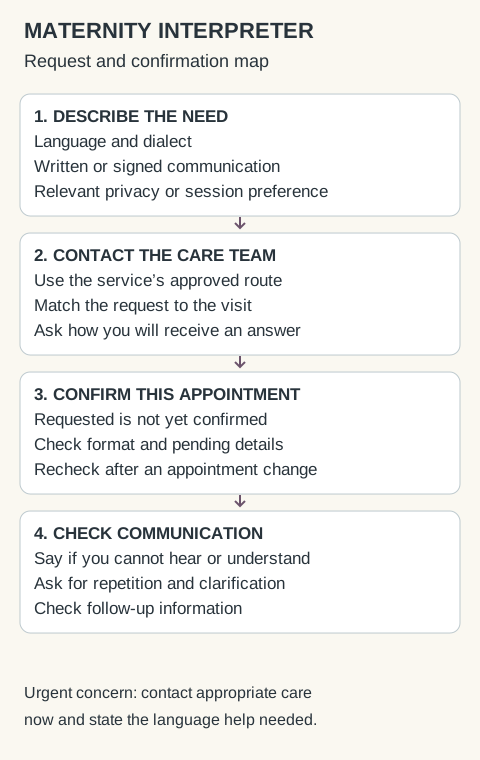
The following cases are fictional booking and communication situations. Try naming the unresolved detail and the person to contact before opening the answer. They do not determine clinical urgency or replace your maternity team’s instructions.
Case 1
The booking says Mandarin, but you need Cantonese to discuss care. Is “Chinese” a sufficient match?
Show answer and explanation for case 1
Ask the clinic to correct and confirm the spoken language.
The government guidance explicitly distinguishes Mandarin and Cantonese. A broad label or a preferred written script does not confirm the language needed for the conversation.
Case 2
Your partner wants to attend and can speak English. Does that make professional interpreting unnecessary?
Show answer and explanation for case 2
Keep support and professional interpreting as separate roles.
A companion can give wanted support. The guidance recommends offering professional interpreting when language is a problem in health discussions and says children should not interpret. Tell the team what communication help you need.
Case 3
The clinic offers a translated leaflet, but reading that language is difficult. Is the written-language request finished?
Show answer and explanation for case 3
Explain what you can use and ask for the information to be explained accessibly.
A preferred spoken language does not establish reading ability. The guidance describes alternatives such as spoken explanation; the service must confirm what it can arrange.
Case 4
You receive a new appointment time. The earlier interpreter confirmation still has the old time. What needs checking?
Show answer and explanation for case 4
Check both the appointment and the language-service booking.
A confirmed request belongs to specific arrangements. Ask the team to update the booking and explain the confirmation or cancellation process rather than assuming it moves automatically.
Case 5
An urgent maternity concern arises while your routine interpreter request is still pending. Should you wait for that confirmation?
Show answer and explanation for case 5
Contact the appropriate maternity or emergency service now and state your language need.
A routine preparation record is not a triage system. Use your care team’s urgent instructions and ask for communication help through that service without delaying contact.
Case 6
You recognise the assigned interpreter socially and do not feel comfortable discussing private concerns. What can you say?
Show answer and explanation for case 6
Tell staff privately about the concern and ask about another arrangement.
The guidance says conflicts of interest should be checked before a session. Knowing an interpreter personally can affect willingness to disclose health information; do not assume you must continue silently.
Case 7
During a telephone session you cannot hear the interpreter, but the discussion continues. Is a connected call enough?
Show answer and explanation for case 7
Say that you cannot hear and ask the team to pause and resolve the problem.
The purpose is understandable communication. A connected line with poor sound does not achieve that; ask for repetition once the connection works and record any remaining question.
Case 8
You have an English summary after the appointment and can translate ordinary words with an app. Does that confirm you understood the care instructions?
Show answer and explanation for case 8
Ask the team to explain unclear instructions using professional language support.
The government guidance advises against automated online translation in healthcare settings because quality is not assured. A translated word list or letter is not the same as an understood care conversation.
Sources and further reading
- UK government: Language interpreting and translation — migrant health guidePreferred language and dialect, professional interpreting, written information, booking, privacy and working with an interpreter. The guidance is for practitioners and was last updated 22 March 2021; the scripts and worksheet are original.
- Cambridge University Hospitals: Before your appointmentA current published local example of telling the referring or appointment team about communication needs and contacting CUH Accessibility. It does not confirm a personal maternity interpreter booking or a universal hospital process.
Keep the workplace request separate
If Great Britain employment guidance applies to you, check antenatal time off, travel and the first-appointment evidence distinction. An interpreter request and a work absence need their own answers.