Practical guide
A Practical Help Rota for the First Days Home with a Newborn
Turn offers into agreed household jobs with a named person, a window and a backup. A fictional three-day rota, meal handoff, visitor preferences and two blank records make gaps easier to act on.
Start with wanted help and a short planning period
A useful help rota for the first days home with a newborn answers four ordinary questions: what needs doing, who has accepted it, when it can happen, and what changes if the person is unavailable. Start with meals, groceries, laundry, kitchen cleanup and other household jobs the family actually wants covered.
The NHS relationship guidance recommends being clear about the kind of help you want and sharing household and childcare responsibilities. A written rota is an original way to put that conversation into practice. The source does not prescribe the three-day example below or a required number of helpers.
Choose a short period you can realistically review, such as the next three days. One trusted person can collect offers and update the working copy if the family wants that support. That person coordinates agreed tasks; the recovering parent still gets to express preferences and change an unwanted arrangement.
Ask one concrete question before accepting an offer: “Would a grocery delivery, laundry load or short visit be useful today?” A meal can be welcome while a long social visit is not. A friend who lives far away may help arrange an agreed delivery or check who has confirmed a job.
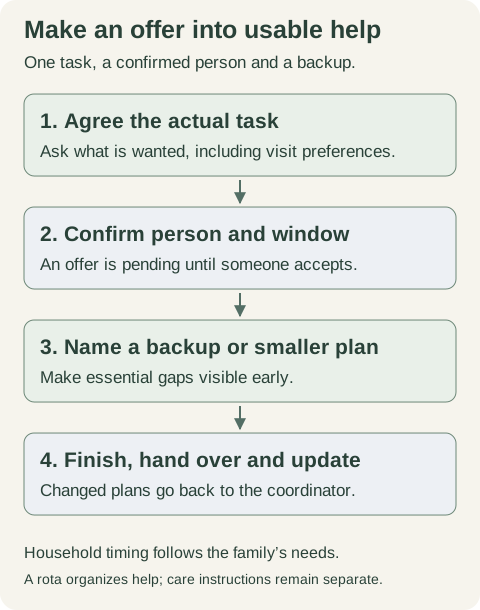
Turn an offer into a task with an owner and a finish line
| Detail | A concrete example | What to confirm |
|---|---|---|
| Task | Wash, dry and put away one agreed laundry load. | Which load and where the supplies are. |
| Person and window | Jo has accepted the afternoon task. | Availability and any access arrangement. |
| Completion | Clean items are returned to the agreed place. | A short update when the task is done. |
| Backup | Leave the nonessential load or ask Sam. | Whether the backup has accepted or is still pending. |
“Help around the house” makes the tired person invent and supervise the job. A specific task lets the helper arrive with a clear purpose. Include the supplies or information that actually matter, such as the grocery list, laundry preference or delivery location.
A row can be pending, confirmed, changed or completed. Use those words honestly. Naming someone without asking them creates an expectation, not reliable cover. Likewise, a backup is only confirmed when the person or service has accepted the arrangement.
One person can do several jobs, and one job can be simplified if support is limited. The rows are responsibilities, not a requirement to recruit a large group. Decide which tasks can wait, which can be smaller and which gaps need another arrangement.
Use this fictional three-day rota as a starting point
The example uses invented names and ordinary household windows. It shows how a plan can include meals, chores, an existing school-run arrangement and an optional visit. Replace every row with jobs, people and timings that fit your situation.
| Day | Window | Helper | Task | Backup or simpler plan | Status |
|---|---|---|---|---|---|
| Day1 | Morning | Alex | Buy the agreed groceries | Sam / smaller order | Confirmed |
| Day1 | Lunch window | Sam | Deliver an agreed meal and handoff note | Alex / agreed alternative | Confirmed |
| Day1 | Afternoon | Jo | One laundry load and clear kitchen counter | Leave the nonessential load | Pending |
| Day2 | Morning | Alex | Check the list and replace needed groceries | Delivery if agreed and available | Confirmed |
| Day2 | Lunch window | Jo | Prepare the agreed food; finish kitchen cleanup | Sam / simpler agreed meal | Confirmed |
| Day2 | Afternoon | Sam | Short visit only if wanted; one agreed chore | Change to doorstep delivery | Confirm again that day |
| Day3 | Morning | Jo | Take the agreed school-run task | Existing childcare backup | Confirmed |
| Day3 | Lunch window | Alex | Meal handoff and supplies check | Sam / agreed alternative | Confirmed |
| Day3 | Afternoon | Sam | Review tomorrow’s help gaps | Message the coordinator | Confirmed |
“Confirm again that day” is useful for a visit because the family may feel differently when the time comes. It is not a promise that the baby will be asleep or the recovering parent will be available to entertain. The coordinator can send a short update before someone travels.
Keep the schedule flexible around actual feeding, care appointments and recovery instructions. A morning or lunch window belongs to the helper’s job. It does not set the baby’s feeding intervals or turn a household timetable into a clinical plan.
At the review, ask what was completed, which offers felt useful and what needs changing tomorrow. A lighter plan that people carry out can be more useful than filling every cell with an unconfirmed name.
Plan the meal handoff, not only who cooks
Agree food preferences, portions and any allergy arrangements with the person receiving the food. A helper should know what is wanted before buying or cooking, and should not improvise a special postpartum diet or describe a meal as allergy-safe without the relevant agreement.
| Check | Record before delivery | If it is unclear |
|---|---|---|
| Food and preference | What is coming and the family’s agreed requirements. | Ask before preparing or buying it. |
| Delivery | A window and the person receiving the food. | Change the timing or choose an agreed alternative. |
| Storage | The applicable storage instructions and who puts it away. | Clarify the instructions rather than leave the food waiting. |
| Later use | Label and any freezing, defrosting or reheating instructions. | Follow the food’s instructions and qualified food-safety guidance. |
The Food Standards Agency guidance explains chilling, freezing and defrosting, including following packaging instructions, labeling frozen food and defrosting in the fridge. Use those instructions for the food actually supplied. This planning table does not replace a product label or establish one universal rule for every meal.
Confirm who receives a chilled delivery and manages the storage handoff. A doorstep drop can reduce social pressure, but it still needs a receiving arrangement. Make the completion update specific: “Delivered to Alex and stored according to the instructions,” rather than only “food dropped off.”
Keep the request proportionate. Groceries, an agreed prepared meal or kitchen cleanup may be useful alternatives when someone cannot cook. A helper can offer an option and accept a refusal without asking the family to explain private health details.
Agree visits, photographs and the kind of help wanted
A social visit and a working help slot have different purposes. Ask whether the family wants company, a doorstep delivery, a short chore visit or a message for now. Someone offering to meet the baby should not automatically be assigned a caregiving role.
Record the arrival window, visit length and how a change will be communicated. “Please message before leaving; today may need to become a doorstep delivery” is a usable arrangement. The family can shorten or decline a visit even when the offer was well intended.
Ask about photographs and sharing before taking or posting them. Keep private spaces and documents off the shared household copy. A helper usually needs the task, access details and instructions relevant to that job, rather than a full health history.
The NHS relationship page notes that support needs can differ between families and that relatives may not know what is wanted unless it is explained. Use that principle to make the plan clearer, rather than assuming everyone wants the same number of visitors or the same form of help.
For help involving another child, a pet or an existing childcare arrangement, agree the exact responsibility and any necessary permission first. “School run” in the example means an arrangement already accepted by the relevant adults; it is not permission to collect a child because someone added a name to a table.
Make support gaps visible and use the help available
| Situation | A practical adjustment | Keep this clear |
|---|---|---|
| A helper is unavailable | Contact the agreed backup or simplify a nonessential chore. | Change the status and tell the relevant person. |
| Support is mostly remote | Use agreed deliveries, coordination or a short check-in. | Remote help needs acceptance and a real completion step. |
| No partner or large family network | Choose essential jobs and ask local services about available support. | A rota is not a fixed-number-of-companions requirement. |
| An appointment changes the day | Revise household windows around the actual care arrangement. | The calendar does not decide appointment or urgent-care timing. |
The NHS services page describes midwives, health visitors, local family services and parent support options in its UK setting. It does not guarantee a home helper, funded delivery or a particular service for every reader. Ask your own maternity team or relevant local service what is available when a gap cannot be covered by friends or family.
Keep your discharge instructions and care contacts accessible. NHS early-days and after-birth guidance describe professional follow-up and situations needing prompt attention. If an urgent concern arises, use the appropriate care or emergency route; completing the rota or waiting for a routine helper should not delay it.
A coordinator can help with practical access, notes or a changed household task if asked. They do not need to interpret symptoms, change medicines or rewrite the baby’s individual care instructions to be useful.
For the day of discharge, use the separate maternity transport guide. It deals with the ward update, actual vehicle and infant-seat instructions. This rota begins with household help after arrival and keeps that different planning task visible.
Use one working rota and one family-preferences record
Copy the records below, fill only the details that are useful and choose who sees each copy. A helper can receive their own task instead of the whole household conversation. Update the date or next review so people know which arrangement is current.
FIRST DAYS HOME - HOUSEHOLD HELP ROTA
Period covered / next review:
Person updating this working copy:
Day and agreed arrival or completion window:
One specific household task:
Person who has accepted the task:
Supplies or access actually needed:
What completion looks like:
Backup or simpler plan if this falls through:
Confirmed / pending / changed / completed:
Next update and who receives it:
FAMILY PREFERENCES - SHARE ONLY WHAT A HELPER NEEDS
Tasks wanted now / tasks not wanted:
Food preferences and agreed allergy arrangements:
Delivery location and storage handoff:
Visit wanted / doorstep delivery / message only:
Arrival window and how to confirm:
Visit length and who ends or changes it:
Photo and sharing preferences:
Private spaces and information to keep private:
Children or pets - specifically agreed task:
Who can revise these preferences today:
Download both blank records, the example rota and six answer notes (TXT).
The preferences sheet is a starting conversation, not a demand to disclose everything. “No photographs,” “message first” or “leave this job until tomorrow” can be complete instructions. The person receiving help can revise them as the day changes.
Try six checks before treating an offer as confirmed help
These fictional cases check whether a household arrangement can actually be carried out. They are planning exercises, not observed family outcomes or assessments of newborn care.
Case 1
A friend says “I can help sometime next week.” May the rota mark tomorrow’s lunch delivery as confirmed?
Show answer and explanation for case 1
No. Agree the task and window, then get an actual acceptance.
A kind offer is not yet a scheduled delivery. Use “pending” and keep the meal’s alternative visible until the person confirms.
Case 2
Two people are bringing meals, but nobody has agreed to put them away. What is missing?
Show answer and explanation for case 2
The food-storage handoff needs a named person and instructions.
Delivery and receiving are separate tasks. Confirm what food is coming, how it should be stored and who will handle it instead of leaving it by the door.
Case 3
A visitor has offered to hold the baby. The family wants laundry help instead. Which task belongs in the rota?
Show answer and explanation for case 3
The task the family actually wants and the helper agrees to do.
A visitor’s preferred activity does not define useful support. A clear laundry task or a respectfully declined offer can reduce pressure on the recovering parent.
Case 4
The usual helper becomes unavailable. Should the coordinator quietly keep the task marked confirmed?
Show answer and explanation for case 4
No. Mark the change, contact the backup or simplify the plan, and tell the relevant person.
The status should describe what is real. An honest gap makes another arrangement possible; an unchanged tick conceals a task that still needs help.
Case 5
Does the example’s lunch window set a newborn feeding time?
Show answer and explanation for case 5
No. It is a window for an agreed household job.
The rota assigns help. Feeding, sleep and individual care arrangements follow the baby’s needs and the family’s care guidance, rather than a fictional example table.
Case 6
A group chat requests everyone’s discharge notes so helpers can organize chores. Is that information needed for the household copy?
Show answer and explanation for case 6
Usually the helper needs the practical task and relevant instructions, not the whole private record.
Keep personal health documents and contact details with the people you choose and the appropriate care route. Share enough to perform the task without making a general group chat the medical record.
Sources and further reading
- NHS: Relationships after having a babyClear requests for wanted help and shared responsibilities; the rota itself is original.
- NHS: Services and support for parentsUK support-service examples and routes to ask about local help; no universal eligibility promised.
- NHS: Early daysEarly postnatal care and follow-up context; household windows do not prescribe baby feeding.
- NHS: Your body after the birthRecovery and professional-contact context; no treatment or individual clinical plan supplied.
- Food Standards Agency: How to chill, freeze and defrost food safelyStorage instructions, labeling and fridge defrosting for a meal handoff. The linked publication is dated 18 December 2017.