Practical guide
Newborn Physical Examination: First Check and the 6–8 Week Review
Keep the first and repeat newborn examinations separate, ask what a combined invitation includes and record the explanation and next appointment.
There are two offers to keep visible
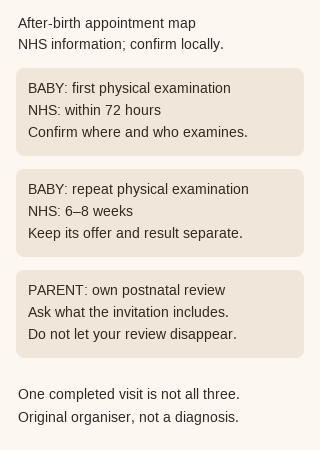
The NHS offers a newborn physical examination within 72 hours after birth and another examination at 6–8 weeks. The later check is not simply a duplicate tick: NHS information explains that some conditions can develop or become apparent later.
Keep the first and repeat examination as separate appointment and result entries. “Baby checked before we went home” describes the first visit, not whether the later offer has been arranged. A parent’s own postnatal review is a further, separate care task even when appointments happen close together.
This guide uses NHS newborn physical examination information. It organises the offer, questions and records. It does not teach a home examination, interpret an individual finding or replace a plan from your own care team.
Confirm who is examining the baby and where
A trained midwife, nurse or doctor carries out the examination. The first often happens in hospital before going home, but the NHS also describes home, GP, community-clinic or children’s-centre arrangements. The repeat is usually with a GP or in a community setting. Check your service’s actual invitation rather than assume the place is unchanged.
- Ask whether the first examination has been offered and, if it has happened, where the result is recorded.
- Keep the repeat offer visible with its own booking status and responsible service.
- Ask whether a combined invitation includes your own postnatal review. Do not assume a baby-only appointment covers both people.
- Keep the contact route for an unconfirmed offer or a changed visit with the current note.
If the examination was not offered within the first 72 hours or at 6–8 weeks, NHS guidance says to speak to the midwife, health visitor or GP. An earlier individual instruction still matters; this public information does not tell you to wait with a care concern.
Know what is being checked and ask about the offer
The practitioner checks the baby generally and specifically looks at the eyes, heart, hips and, where applicable, testicles. The NHS explains that these targeted checks look for particular conditions. That is a description of the professional examination, not a checklist for a parent to reproduce at home.
The practitioner may ask about feeding and family health history. Use the information you actually have; if something is unknown, say so rather than fill a record with a guess. The baby is undressed for the examination, and you can ask questions about what the examiner is doing.
Information about the offer is given during maternity care and again after birth, and consent is discussed. A useful question is: “What does this examination cover, and what will happen if you find something that needs another check?” Ask the examiner to explain the part that matters to your situation.
Do not use a completed routine screen as a conclusion about every future health issue. This appointment guide deals with scheduled examinations; concerns about the baby use the appropriate care route and individual instructions.
Record the explanation and any further appointment
The NHS says examination results are given straight away. The practitioner explains any findings and what needs to happen next, and the results should be recorded in the baby’s red book. If another assessment is needed, ask which service is arranging it and how you will know the arrangement is confirmed.
Swipe the table sideways on a narrow screen, or focus the table and use the right-arrow key.
| Care task | Example status | Next practical question |
|---|---|---|
| First baby examination | Done; examiner’s explanation received | Is the result recorded in the red book? |
| Any additional assessment | Practitioner says a referral will be arranged | Which service confirms its appointment? |
| Repeat baby examination | Offer mentioned; date not yet confirmed | Who is booking the 6–8 week review? |
| Parent’s own postnatal review | Separate invitation still to check | Does the booked visit include my own review? |
The table is an invented planning example. It does not describe findings or recommend an assessment. Its value is that an open booking remains open even when another row is complete.
A useful closing question is: “What is the next step, who is arranging it, and whom should I contact if I do not receive the information?” Keep the answer beside the appropriate care task. A red-book note, appointment letter and parent’s review agenda serve different purposes.
Three checks before calling the plan complete
These fictional examples test appointment organisation, not clinical examination skills.
Case 1
The first examination took place before discharge. Can the later baby examination be removed from the planning note?
Show answer and explanation for case 1
No. Keep the separate 6–8 week offer visible.
The NHS describes a repeat examination because some conditions can develop later. Record the later appointment or its open booking step rather than assume the first visit replaces it.
Case 2
A letter mentions the baby’s examination but says nothing about the parent’s postnatal review. Is the parent’s review confirmed too?
Show answer and explanation for case 2
Not from that wording alone. Ask what the invitation includes.
The parent and baby have separate care needs. The existing parent-review guide helps prepare that question; a combined time slot should not make the parent’s own check disappear.
Case 3
The examiner says another assessment will be arranged. Is a referral note enough to mark the next appointment as booked?
Show answer and explanation for case 3
No. Keep the referral and booking statuses separate.
Ask which service is arranging the assessment, how the invitation will arrive and whom to contact about a missing arrangement. The appointment organiser does not interpret the finding or choose treatment.
Take the right question to the right visit
For an unconfirmed repeat examination, ask: “The first check was done, but I do not have the later appointment. Who is arranging the repeat, and where will it happen?” For a result question, use the explanation and care contact given by the examiner rather than ask a household helper to interpret the red book.
Use the parent’s postnatal appointment guide for your own review and the three-offer newborn screening checklist for the wider baby plan. Hearing screening and blood spot collection have their own results and follow-up routes; a physical examination does not close those rows.
Keep the current note short enough to update when an appointment changes. The goal is not a perfect timetable. It is knowing which care task happened, what was explained and which next step remains unconfirmed.
Sources and further reading
- NHS: Newborn physical examinationFirst examination within 72 hours, repeat at 6–8 weeks, four targeted areas, consent, locations, results and red-book record. No self-examination or diagnostic interpretation.