Practical guide
Newborn Screening Checklist: Keep Three Offers and Follow-ups Separate
Compare three newborn screening offers, distinguish procedures from results and use a filled example plus a private blank appointment record.
One completed screen does not finish the whole plan
Newborn blood spot screening, hearing screening and physical examination answer different questions and follow different paths. Keep three separate offer rows, and split the physical examination into its first and repeat checks. Completion of one row is not evidence that the other tests were offered, performed or explained.
The organiser below uses the three NHS public screening pages. It is useful when discharge notes, home visits and later letters arrive at different times. It is not a medical schedule for every baby, a condition checklist or a worldwide screening standard. Follow your own team’s instructions and confirm the local programme.
Start from what is actually known: the named test, the offer, the confirmed appointment, the procedure completed, the result explained and any next step. Leave a gap visible if the information is missing. An honest “not yet confirmed” is more useful than a tick based on an assumption.
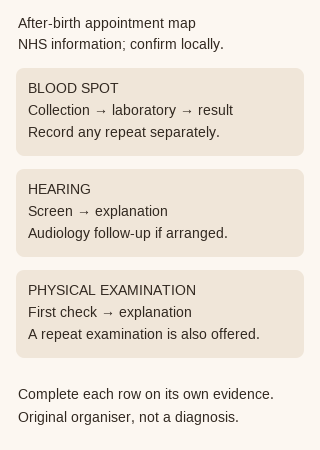
Compare the timings and result routes without merging them
Swipe the table sideways on a narrow screen, or focus the table and use the right-arrow key.
| Offer or check | Usual NHS description | Result and contact point |
|---|---|---|
| Blood spot collection | Normally day 5; sometimes earlier or later | Results by 6 weeks or sooner depending on result; if missing by 6 weeks, ask midwife, health visitor or GP |
| Hearing screen | Usually before 4 weeks; can be up to 3 months | First result straight away; no offer: ask health visitor, GP or local hearing screening service |
| First physical examination | Within 72 hours | Result straight away; if not offered, speak to midwife, health visitor or GP |
| Repeat physical examination | 6–8 weeks | Keep this offer and explanation separate from the first examination |
The ages in the table describe NHS public information. They do not override an earlier contact instruction, a different individual care plan or another jurisdiction’s programme. In particular, blood spot collection and blood spot result communication have different timings.
For the detailed route, use the blood spot appointment and results guide, hearing and audiology guide or first-and-repeat physical examination guide. Those pages explain the test-specific next step; this page keeps the whole set of offers visible.
Build one working record from the actual documents
- Write each offer in its own row. Use the exact test name from the service, not only “baby check.”
- Add the appointment status: not yet offered, request made, arrangement confirmed, changed or completed. A request is not a confirmed booking.
- Keep the procedure and result statuses apart. “Sample taken” and “result explained” are not interchangeable.
- Add the next action, responsible service and actual contact instruction. A helper can help with transport or a message; the care service confirms the appointment and explains results.
- Update only the row that changed. A rescheduled hearing visit does not alter whether the blood spot result has arrived.
Use the actual red-book entry, letter or practitioner explanation as appropriate. If two messages conflict, ask the responsible service which instruction is current. This record helps identify the question; it cannot settle a booking discrepancy itself.
Swipe the table sideways on a narrow screen, or focus the table and use the right-arrow key.
| Row | What is known | Action still open |
|---|---|---|
| Blood spot | Sample collected; result not yet received | Receive the result through the agreed route |
| Hearing | Screening practitioner says an audiology visit will be arranged | Confirm the actual follow-up appointment |
| First physical examination | Completed; explanation received | Keep any stated next step with the record |
| Repeat physical examination | Later offer mentioned, no date yet | Ask the arranging service about the appointment |
This is an invented example without clinical findings. The family has completed some procedures and still has several legitimate planning tasks. Nothing in the table establishes a diagnosis or requires a new test.
Make a useful handoff without sharing the whole health record
Choose one current working copy and say who can update it. A helper arranging a lift may need the appointment name, place, current time and how changes will be communicated. They do not automatically need every screening result, private document or family history.
A clear handoff is: “The blood spot sample is collected and the result is pending. The hearing follow-up is not yet confirmed. Please help me check the clinic arrangement; leave the other rows as they are.” It assigns a practical task without asking the helper to interpret a result.
Keep the parent’s own postnatal review as a separate care task. A baby’s invitation does not prove that the parent’s review is included. Use the existing parent-review guide to ask what the appointment covers and prepare the questions that matter to you.
For household chores around these visits, the home-help rota records accepted jobs and backups. It can change around the appointment; it does not determine the baby’s screening or care timing.
Three cases that expose a hidden planning gap
These invented cases demonstrate how to use the record, with no patient outcomes implied.
Case 1
The hearing screen is complete and its result was explained. The blood spot row only says “home visit expected.” Can the family mark all screening complete?
Show answer and explanation for case 1
No. The blood spot arrangement remains unconfirmed, and the other rows need their own evidence.
Different offers are not interchangeable. Ask whether the home visit includes collection and confirm its arrangement; do not transfer the hearing result tick to another test.
Case 2
One helper has a letter saying audiology follow-up, while another has planned a few-minute visit based on the first screen. What should the shared note resolve?
Show answer and explanation for case 2
Identify the actual visit and update the practical arrangement.
The NHS describes a longer audiology visit, including settling. Use the current invitation and clinic instructions to confirm the visit; old screen duration is not a plan for the follow-up.
Case 3
The baby’s later examination is booked. There is no confirmation of the parent’s own postnatal review. Is the after-birth care plan complete for both?
Show answer and explanation for case 3
No. Ask whether the parent’s review is included or needs its own arrangement.
The baby’s examination and parent’s review address different people. The record should make the missing parent appointment visible rather than silently count a baby booking twice.
Copy a short record and leave the next action visible
Use only the fields needed for your next conversation. You can open or download the blank appointment record (TXT) and keep it privately. It is an original organiser, not a form required by the NHS.
Named test and current appointment status:
Procedure completed / result still pending or explained:
Next action and arranging service:
Actual contact or change instruction:
Working-copy date and person updating it:
If a result or arrangement is missing, take the specific gap to the appropriate service. For blood spot results missing by 6 weeks, the NHS directs parents to the midwife, health visitor or GP. For a hearing screen not offered, it names the health visitor, GP or local screening service. For physical examinations not offered in the stated windows, it names the midwife, health visitor or GP.
Do not let completing the organiser delay an earlier instruction or care contact. Its job is to make the question clear enough to ask: which offer, which result and which next step is still open?
Sources and further reading
- NHS: Newborn blood spot testPublic offer, usual day-5 collection, sample procedure, results by 6 weeks, repeat-sample explanation and programme limits. No linked policy or video reproduced.
- NHS: Newborn hearing screeningFirst screen, locations, no-clear-response pathway, audiology appointment duration and limits of a clear screen. No linked detailed audiology booklet or video reproduced.
- NHS: Newborn physical examinationFirst examination within 72 hours, repeat at 6–8 weeks, four targeted areas, consent, locations, results and red-book record. No self-examination or diagnostic interpretation.