Practical guide
Bringing a Meal to a Pregnant Friend: Food Safety and a Clear Handoff
Agree the food, ingredients and receiver; keep preparation, holding, transport and reheating rules separate. Use a fictional handoff, two elapsed-time checks and a private blank record.
Agree the meal and receiver before cooking
Before bringing food to a pregnant friend, confirm what they want, name the ingredients, agree the delivery window and receiver, and plan safe holding and later use. Cooking something generous does not complete the help if nobody can receive or store it.
Ask a practical question: “Would this meal, groceries or kitchen cleanup help? What ingredients or instructions should I know before preparing it?” A preference can change. Do not treat a kind refusal as a request for persuasion or ask for a complete health history to justify it.
Name every ingredient, including sauces, stock, garnishes and substitutions. Keep original packaging for supplied products where useful. An ingredient list is valuable information; it is not an allergy-safety certificate. Agree any relevant allergy arrangements and do not promise the food is suitable if you cannot meet them.
This guide uses US FDA food-handling guidance for the stated temperatures and holding rules. It does not prescribe a pregnancy diet, choose nutrients or decide whether a food fits a particular allergy, illness or care plan. Follow the recipient’s individual instructions and the actual food’s qualified preparation guidance.
Prepare cleanly and use the right cooking check
The FDA’s cleaning guidance says to wash hands before and after handling food, scrub with soap for at least 20 seconds, and clean surfaces and utensils between foods. Rinse produce under running water; do not wash it with soap, detergent or bleach.
Keep raw meat, poultry and seafood and their juices separate from ready-to-eat food. The FDA social-event handling guidance also describes keeping these raw foods separate in shopping bags and transporting perishables promptly. An ingredient note cannot repair cross-contamination during preparation.
Use a food thermometer and the correct instruction for the actual food. The FDA cooking page lists different requirements for different foods; there is no one cooking number that applies to every recipe. A bubbling sauce or a hot edge does not establish that all parts reached the required temperature.
If you supply a prepared product, retain its cooking, storage and use-by instructions. For a homemade dish, give usable instructions grounded in the food actually prepared. Do not invent a storage lifetime or suggest that a “pregnancy-friendly” name makes an unverified recipe safe.
Keep cold holding, hot holding and reheating separate
On a phone, swipe inside the table. With a keyboard, focus the table and use the arrow keys.
| Step | Rule in the cited FDA guidance | What a helper checks |
|---|---|---|
| Cold storage | Refrigerator at 40°F (4°C) or below. | Use a thermometer; the container or bag alone is not a temperature reading. |
| Hot holding | Keep hot food at an internal 140°F (60°C) or warmer. | Check actual food temperature and the warmer’s capability. |
| Room-temperature holding | Discard perishables left out longer than 2 hours; above 90°F, the limit is 1 hour. | Keep known periods outside control visible; do not reset the clock at delivery. |
| Reheating leftovers | Reheat leftovers to 165°F (74°C). | Check different areas, particularly with microwave heating. |
The FDA chilling page supplies the refrigerator rule; its cooking and social-event pages supply the other rules. These source pages show “Content current as of 09/27/2018.” They were accessed for this guide on 10 November 2026; that access date is not a new publication or clinical review date.
Hot holding at 140°F is not the same job as cooking poultry or reheating leftovers to 165°F. Likewise, a two-hour transport journey is not automatically unsafe if correct temperature control has been maintained, and a short journey is not automatically safe if handling is unknown. The rule concerns the food’s conditions, not a blanket permitted driving time.
A cooler with ice or cold packs can help keep food cold. Check the arrangement and temperature rather than assuming that the word “insulated” proves cold holding. If safe handling cannot be established, pause the food plan and use an agreed alternative instead of asking the pregnant recipient to guess.
Cool promptly, then arrange the whole transport handoff
The FDA says to refrigerate or freeze perishables, prepared food and leftovers within two hours of eating or preparation. It also says hot food can go into the refrigerator and recommends dividing large amounts into shallow containers for quicker cooling. Do not leave a large pan on the counter for hours because you are waiting for it to become completely cold.
Choose the delivery approach before leaving. For chilled food, check the cold storage and cold-pack arrangement. For hot food, you need a way to maintain and check the required hot holding, rather than merely packing it while warm. Choose containers suitable for the actual food and keep them separate from possible contaminants.
Confirm the named receiver and window again if circumstances change. A doorstep drop-off can avoid an unwanted social visit, but perishable food still needs an actual receiving and storage arrangement. “I left it outside” is different from “the agreed receiver took it and stored it.”
If the receiver cancels, change the window, use another already-accepted receiver or cancel the delivery. Do not improvise a long wait in a car or by the door. The recipient should not have to rescue an unwanted or uncertain food handoff because someone has already cooked.
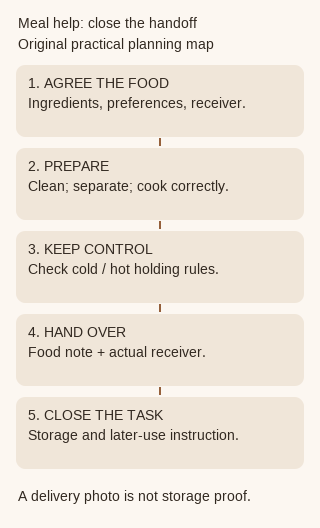
Use a food note that answers the receiver’s next questions
This fictional note shows the information to confirm; it is not a tested recipe, diet recommendation or assurance that a meal is suitable for every pregnancy.
Food agreed: vegetable and bean stew requested by Alex. The helper lists the actual vegetables, beans, oil, seasoning and every stock ingredient; the original stock package is supplied. No unapproved substitution is made.
Handling: prepared and promptly cooled under the actual instructions, in shallow containers. The helper records the preparation date and time, checks the chilling arrangement and agrees a chilled delivery rather than guessing that lukewarm food is fine.
Receiver: Jo has accepted the 16:00–16:15 local window, has space in the refrigerator and will store the containers. Delivery is still pending until that handoff happens.
Later use: the note contains the actual storage and use instructions, the preparation date, and the cited FDA leftover-reheating instruction. The helper does not invent “safe for seven days” or a rule for an unknown recipe.
A receiver can ask: “Which ingredients are actually in it? How was it held before arrival? What instruction applies to storage and later use?” Keep unknowns visible. A neat label with an unverified temperature or missing ingredient is still incomplete information.
For a frozen delivery, agree whether it will remain frozen or be stored and defrosted under the applicable instructions. The FDA describes refrigerator defrosting, cold-water defrosting with water changed every half hour, and microwave defrosting followed by immediate cooking. Do not leave frozen food on the counter to thaw for this handoff.
Check elapsed time without resetting the clock
A simple arithmetic check can expose a gap, but it cannot establish safe handling by itself. Write down known periods outside temperature control. A refrigerator interval is not the same as another period on the counter, and a receipt time does not erase an earlier uncontrolled period.
In a fictional ordinary-room-temperature example, perishable food is out of control for 35 minutes while being packed, 50 minutes during unchilled travel and another 45 minutes waiting for a receiver. That totals 130 minutes: 2 hours 10 minutes. It exceeds the cited two-hour rule. You do not start a new two-hour period when the food reaches the door.
The FDA reduces the limit to one hour when the temperature is above 90°F. A fictional 70-minute period in those conditions exceeds that shorter rule even though it is less than two hours. An example’s weather assumption belongs to that example; it is not a rule that all deliveries have the same limit.
If holding times or temperatures are unknown, do not replace the missing facts with a guess. Check the applicable qualified guidance or choose a different agreed task. Reheating is not a reason to ignore the source’s discard rule.
Send a useful offer, confirmation or change message
Before preparing: “Would [food] help on [date]? These are the ingredients I plan to use, including [stock/sauce]. Please tell me the preferences and instructions you want followed. Groceries or no delivery is fine too.”
Before leaving: “The agreed food and handling note are ready. Are [receiver] and [local window] still confirmed? Please only confirm the receiving arrangement; you do not need to host a visit.”
If it changes: “The receiver is unavailable, so this delivery is not confirmed. I will follow the food’s storage instructions here and use the alternative we agreed, rather than leave it waiting outside.”
These original scripts keep the request clear without making the family discuss private medical details. If a personal food or health question is unresolved, the recipient’s appropriate care professional handles that question; the helper can still offer a different practical job.
Keep a blank handoff record with the food
Use only the information needed for the food handoff. The note should travel with the containers or the relevant receiver, rather than disappear into a busy group chat. Keep filled personal details private.
MEAL HANDOFF - PRIVATE WORKING NOTE
Food agreed / complete ingredients and original packaging:
Preferences and allergy arrangements discussed:
Prepared or supplied date and time / actual instructions:
Cold or hot holding plan and checked temperature:
Delivery window / named receiver and acceptance:
Periods outside temperature control / known or unknown:
Arrival handoff / who stores the food and when:
Storage, defrosting and reheating instructions / source:
Change, uncertainty or cancelled delivery / agreed alternative:
Open the blank meal-handoff record (TXT). Save the text from your browser or copy it into a private note. The website does not receive completed records. For allocating several meals and chores, use the existing home-help rota; this article supplies the separate food-handling handoff.
Check six fictional food handoffs
These examples test the stated rule and the practical handoff. They are not clinical exposure assessments or observed food-safety trials.
Case 1
A meal note names vegetables but omits the stock and sauce ingredients. Is the ingredient information complete?
Show answer and explanation for case 1
No. Include every actual ingredient and relevant packaging.
An incomplete list can hide information the recipient needs. A complete list still does not certify allergy safety or decide personal suitability.
Case 2
A large pot of cooked food will stay on the counter for several hours until completely cold. Does that match the cited FDA chilling guidance?
Show answer and explanation for case 2
No. Cool promptly using the applicable guidance.
The FDA says hot food can enter the refrigerator and large amounts can be divided into shallow containers. Follow its refrigeration timing rather than leaving a large batch out for hours.
Case 3
At ordinary room temperature, the fictional uncontrolled periods are 35, 50 and 45 minutes. Is the total within two hours?
Show answer and explanation for case 3
No. The total is 130 minutes, or 2 hours 10 minutes.
35 + 50 + 45 = 130. It exceeds 120 minutes. Arrival does not reset the period; follow the cited discard rule.
Case 4
A fictional perishable meal stays uncontrolled for 70 minutes above 90°F. Is being under two hours enough?
Show answer and explanation for case 4
No. The cited FDA limit in those conditions is one hour.
70 minutes exceeds 60 minutes. The higher-temperature rule is shorter; do not apply only the ordinary two-hour number.
Case 5
The helper sends a delivery photo, but nobody receives or stores the food. Is the food handoff completed?
Show answer and explanation for case 5
No. Receiving and storage are still unconfirmed.
A photo shows a drop-off, not the food temperature or storage. Confirm a receiver and follow applicable handling instructions rather than leaving perishable food waiting.
Case 6
Does the hot-holding value of 140°F replace the FDA’s 165°F leftover-reheating value?
Show answer and explanation for case 6
No. Holding and reheating are different steps.
Use the correct rule for the actual job and check the food temperature. A warmer, hot edge or bubbling sauce alone does not prove that every part reached the required reheating temperature.
Sources and further reading
- Cleaning (Food Safety for Moms-to-Be)Handwashing, surface cleaning and produce handling. Observed Content current as of 09/27/2018; accessed 10 November 2026. No sanitation-chemical recipe or old survey statistic reproduced.
- Cooking (Food Safety for Moms-to-Be)Food-specific cooking distinctions, two-hour/hot-weather discard rules, 165°F leftover reheating and microwave checks. Observed Content current as of 09/27/2018; accessed 10 November 2026.
- Tips to Chill Food (Food Safety for Moms-to-Be)40°F refrigerator guidance, prompt chilling, shallow containers, cold packs and defrosting methods. Observed Content current as of 09/27/2018; accessed 10 November 2026. No universal storage lifetime inferred.
- Entertaining All Year (Food Safety for Moms-to-Be)Separation in shopping, prompt transport, 140°F hot holding and controlled cold holding. Observed Content current as of 09/27/2018; accessed 10 November 2026. Food-specific avoidance lists and nutrient amounts not adopted.